
Thanks for tuning in for Gathering Waters’ annual summer reading recommendations!
Each year, our staff recommend a book or two that has been on their mind recently. Many of these books are conservation-focused, but many are not. No matter what kinds of books you prefer, there’s sure to be an option for you. Find your next summer read below!
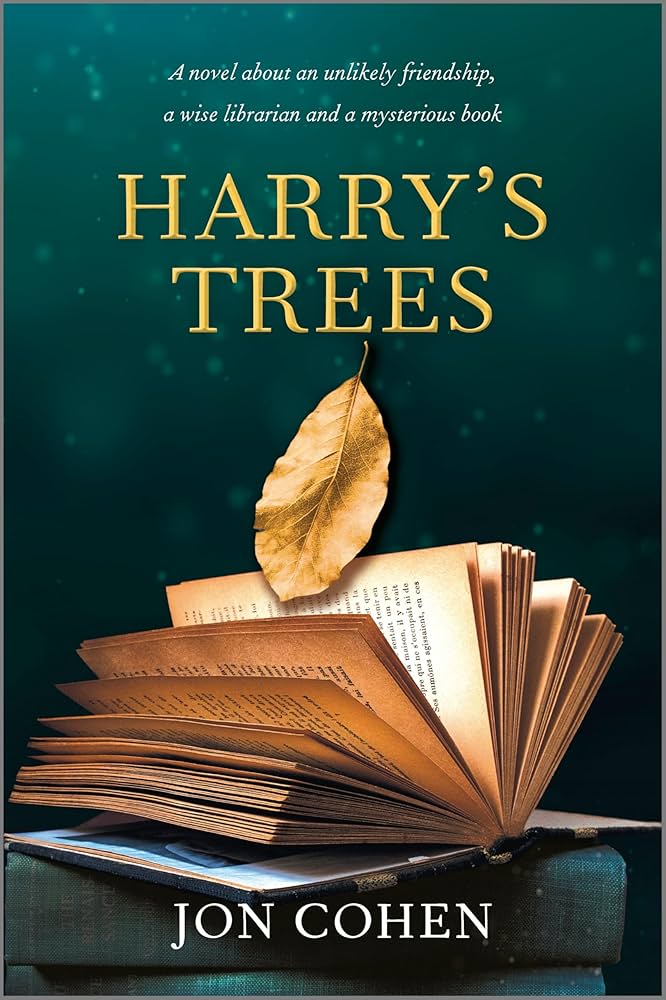
Harry’s Trees
by Jon Cohen
A tale of a man who loves trees and goes to them to find solace, only to find much more than he imagined. This is a story of loss, grief, healing, and the power of connection with a little bit of a fairy tale mixed in. It’s a reminder that sometimes you just need to go hug a tree.
-Cindy Benzschawel, Database and Annual Giving Coordinator

The Comfort Crisis: Embrace Discomfort To Reclaim Your Wild, Happy, Healthy Self
by Michael Easter
I picked this up on a recommendation from my brother, with the goal of challenging myself to rely less on comfort as a default. Easter explores how modern conveniences might be stalling our personal growth, but the highlight of the book for me was his vivid, raw descriptions of his remote travels through the Alaskan wilderness. Whether you’re looking to rethink your daily habits or just want to be transported to some of the most rugged, untouched terrain in North America, this is a great summer read.

A Year in the Wilderness: Bearing Witness in the Boundary Waters
by Amy and Dave Freeman
Imagine spending an entire year living out of a tent—even through the brutal depths of a Minnesota winter. A Year in the Wilderness details the incredible year-long journey of the author and her husband as they immersed themselves completely in the Boundary Waters Canoe Area Wilderness. It is a stunningly beautiful tribute to the wild landscapes, changing seasons, and the resilient creatures that call that place home. It’s the perfect reminder of why protecting these quiet, pristine spaces matters so deeply.
Easy By Nature Blog
by Bill Davison
If your summer schedule doesn’t leave you with hours to sit down with a heavy book, I recommend subscribing to Easy By Nature, a wonderful Substack written by central Illinois biologist, photographer, and Grand Prairie Bird Alliance board member Bill Davison. It is a largely bird-centric digital space packed with breathtaking photography and insightful descriptions of the natural world. It’s a delightful, bite-sized dose of nature that arrives right in your inbox—perfect for enjoying with your morning coffee.
-Heather Brooks, Administrative Coordinator

Piranesi
by Susanna Clarke
This book focuses on the titular character Piranesi, who is an inquisitive and rigorous man living in a fantastical world. “The House” is an infinite building of grand halls lined with statues, a lower floor consumed by a vast ocean, and an upper floor full of clouds. The only other inhabitant of this world is a man Piranesi calls “The Other”, who meets with Piranesi twice a week to discuss his quest to find A Great and Secret Knowledge. The story is told through Piranesi’s meticulous journals, sharing his thoughts and discoveries with the reader as his explorations begin to uncover a world beyond The House; the only reality he has ever known. I am halfway through this book and I am thoroughly enthralled!
-Lily Butler, Events and Outreach Coordinator

Educated
by Tara Westover
Educated is a memoir by Tara Westover emphasizing how education can enlarge your world. The book begins by detailing Westover’s isolating childhood in a fundamentalist Mormon family in the rural mountains of Idaho. At 17, having no formal education, she left Idaho to go to college, and she went on to complete a PhD program at the University of Cambridge. Educated explores Westover’s struggle to reconcile her interest in studying history with the world she inhabited with her family. This is a book I could not put down!
–Mary Endres, Accounting Manager

Liturgies for Resisting Empire
by Kat Armas
I found this book in my search to find an inspiring and grounding force amidst the turbulence of modern times. Kat Armas provides a roadmap for those seeking a countercultural way of living that prioritizes community and humanity over dominance and power. Combining spiritual practices and biblical theology, she helps readers create authentic belonging to God, themselves, each other, and creation. “Empire,” as used in the title, is defined broadly: any system, whether political, theological, cultural, or personal, that relies on power and fear rather than love, humility, and mutual care. Drawing on decolonial and postcolonial interpretations of Scripture, Armas examines how empire has operated throughout history and how the early church resisted Roman imperial power by building communities centered on God’s kingdom values, offering readers a path toward liberation from systems of exploitation today.
-Chris Gutschenritter, General Counsel

Migrations
by Charlotte McConaghy
I was looking for a book to fit my book club’s theme of “survival” and I chose Migrations by Charlotte McConaghy. This novel is centered around a young woman, Franny, who is determined to track the migration of the last remaining Arctic terns as they journey from the north pole to the south pole. This novel is slightly dystopian, set at a time when many species are already or nearly extinct. Franny attaches tracking devices to three birds and travels via a small fishing vessel – she convinced the crew that the terns would lead them to large hauls of fish. The story is quite bleak and sad at times, as much about Franny’s personal life as about the birds and the journey. The writing was both concise, bringing this book in at less than 300 pages, and beautiful, which I think is hard to achieve. I really got immersed in the setting and will remember this book for a long time.
-Amanda Jutrzonka, Communications and Operations Manager

James
by Percival Everett
James is a reimagining of Mark Twain’s Adventures of Huckleberry Finn, told from the perspective of the character Jim. The book follows the same basic plot as Huck Finn, but Everett provides rich details about the complexity and horrors of Jim’s life that Huck did not see or could not understand. I loved the ingenious concept of flipping the narrative of such a well-known classic, and since reading this book I have found myself considering the untold stories of many other familiar characters.
–Elena Kruse, Land Conservation Law Program Intern

Thirty-Two Words for Field
by Manchán Magan
Like all good Irish stories, this book spirals through history, politics, religion, and fairies to highlight the way the Irish language is rooted in the landscape. Each Irish word described has more meaning than you might expect. It’s made me think about the ways we actively create and maintain our culture through language. I’ve been pondering how the words we use to describe the places our conservation community is protecting affect our relationship to the land and each other. If any of that resonates with you or you’re a person who loves a rambling non-fiction work on language or landscapes, this is a lovely addition to your reading pile. The audiobook version is particularly helpful for those who want to hear the authentic Irish language spoken aloud!
-Danni Niles, Director of Philanthropy

Watership Down
by Richard Adams
I’ll start with my all-time favorite book, which I’ve read at least three times. At its heart, it’s an adventure story about a group of rabbits overcoming obstacles in search of a new home. It seems odd to think of an adult book where the characters are rabbits, but somehow it just works. With bits of folklore, genuine suspense, and many parallels to humanity and society, it captures the spirit of a classic adventure in a way few modern stories do. It’s a favorite in my family across multiple generations, and delivers a satisfying – and emotional – ending.
-Amanda Sherer, Donor Communications Manager